About Rebecca Lemov
I study the forces that shape how we think — and share them so you can see the world differently.
My Story
Throughout my life, I’ve been fascinated by how ideas form—how they drift through the mind, tangle with experience, and transform us in ways both subtle and profound. This story traces back to my student years, when I first discovered that understanding the mind sometimes means entering it from the inside.
The Early Struggle to Write
When I was in college facing a looming paper deadline, I often struggled to pull my ideas together. I’d think, if I can just read one more article or one more book on the topic, I’ll know what I want to say. I’ll be able to synthesize it all! Sometimes that process (okay, call it procrastination) led to days of delay while I dredged the library for new sources.
Inevitably, the time would come when I had either read everything I could find or was so close to the deadline that I really had no choice but to start writing. This was the hard part—until I invented a secret method.
My Discovery of a Strange Method
The method was — I would stuff my head full of thoughts, writings, notes, musings, and then lie down on the couch in our common room with a note pad stationed on a nearby table. The pad had to be very close to hand, with a pen ready.
Next, I’d fall asleep (this was easy, as I was a chronically sleep deprived college student), and just as I was halfway to full oblivion — in a state I later learned was called the hypnogogic state—all that had been floating around in my head would coalesce.
I’d somehow wake myself up before reaching full sleep, and, while only half conscious, would jot a note on the paper — a memory-jogging phrase of some sort. When I turned to the note later (after a nap) I would usually be able to decipher the phrase. Say “trail of flowers” or “avenue of infinity” or “free will is not free” in a way that allowed me to organize my paper and write it according to that theme. It still amazes me that this worked.
Realizing the Power of Altered States
It’s now decades later. I look back at my long career studying how people are changed — coercively persuaded — through brainwashing. I’ve explored how techniques and technologies can affect our psyches and how normalized dissociative states can be.
When I reflect on it all, I often return to that early method. In fact, I didn’t quite invent it, and it turns out that several famous thinkers, such as Aldous Huxley, were known for using sleep states and half-sleep states for inventing things or organizing their ideas.
Although today I use meditation for the same purpose, my hypnogogic nap strategy was one of the first times I realized definitively that I could change my own state of mind for the better. I could access an altered state to gain new knowledge.
From Curiosity to Career
Years afterwards, having finished my undergraduate degree in English literature from Yale and graduate school in the anthropology of science at UC Berkeley, I saw a throughline to my old method. It caused me to start teaching a class in the history of brainwashing and mind-control techniques while I was a postdoctoral scholar at the University of Washington.
The Big Questions That Still Drive Me
The reason I did this was that at the heart of what we call brainwashing are a series of questions.
- How are we changed in different situations?
- Are you really you?
- Can we be changed against our will?
- What are the nightmare scenarios in which this seems to have happened—to POWs, to people who join cults, to those who are kidnapped or abused, or to others who simply get engrossed in our screens?
- How do people tend to collaborate in some of these negative transformations?
- What if we are much more malleable than we think?
- Can we use this capacity for good, for positive transformation?
Where My Work Has Taken Me
My work has led me down many unexpected paths—from Cold War archives to modern-day studies of technology and the human mind. Each chapter builds on a single fascination. I explore how influence, persuasion, and emotion shape who we become in an age of rapid change.
The Search to Understand Influence
I’ve spent my life as a researcher endeavoring to understand problems such as how influence works, what is brainwashing (and is it real or just a paranoid reaction?), and the effects of media manipulation as it unfolds through technological and technical change. (The answer to the brainwashing question is yes—it is real.)
All Research Is Me-Search
My research is a personal project as well as a scientific one — as the saying goes, “All research is me-search” at some level. I’m interested in how all of us, including myself, are being changed by the forces and influences we encounter in ways that are sometimes hard to identify — unless you know where to look.
Unless we cultivate the skills to observe, and the knowledge of history to tell what exactly is emerging, we may be at the mercy of cleverly designed extractive technologies.
Coevolving with Machines
As artificial intelligence installs itself at every level of our society, we will have to hone these skills even more effectively. We must find a way to co-develop with these emergent machines and avoid delusional feedback loops.
The Idea of Hyper-Persuasion
Hyper-persuasion is a phrase I coined during my research to describe the effects of social media and digital life, and how they connect to unresolved trauma in each person.
Hyper-persuasion is, in essence, the hyper-personalization of media targeting.
Because AI is amped-up hyper-persuasion — faster, sharper, and more intense — we must examine the emotional throughline that is more powerful than ever before.
The Role of Emotion and Insight
This brings me to a key point I want to reiterate: one of my primary findings is how emotions — and trauma episodes as well as unbearable feelings that most people have gone through — are tapped into by technological systems.
How can we understand this “trauma mining”? Here is where insight becomes pivotal. This is true for all of us, no matter how unstable the truth is — there is always a possibility of insight.
Why This Matters
The questions I study aren’t abstract puzzles. They’re living questions that touch how we think, relate, and decide every day. Our attention, emotions, and beliefs are shaped by invisible systems — media, algorithms, and cultural narratives — that operate in the background of our lives.
Understanding how these forces work isn’t just an academic pursuit. It’s a way to reclaim a measure of freedom and insight in a time when both feel increasingly fragile.
If we can recognize how influence operates, we can also learn how to resist it, repurpose it, and maybe even use it to create something closer to truth and more humane.
Explore My Work
My work takes many forms, including books, talks, essays, and media conversations. Each is another way of exploring how ideas, influence, and imagination shape our shared reality.
Books
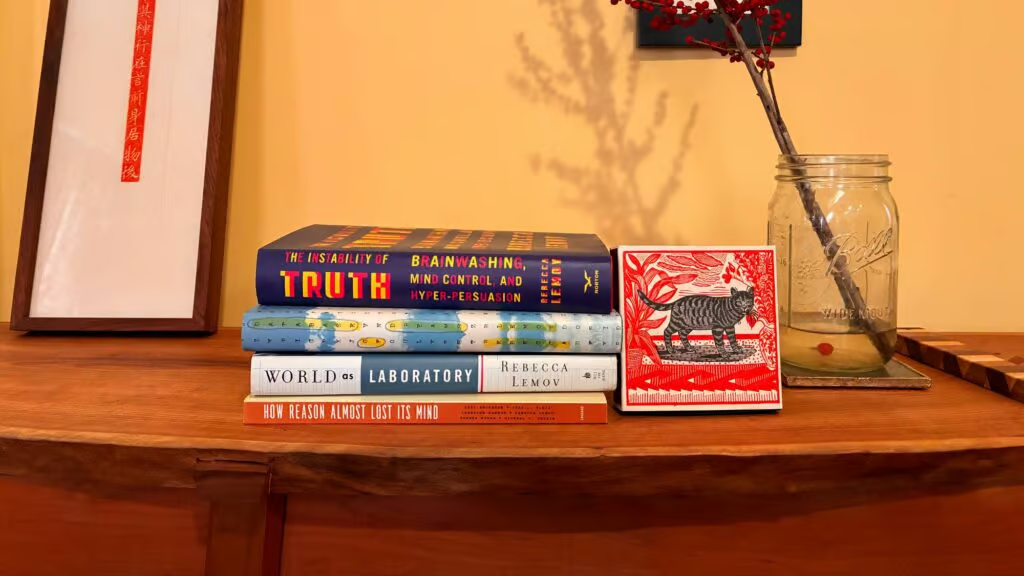
Four published works, including The Instability of Truth and Database of Dreams, blending research and storytelling.
Speaking
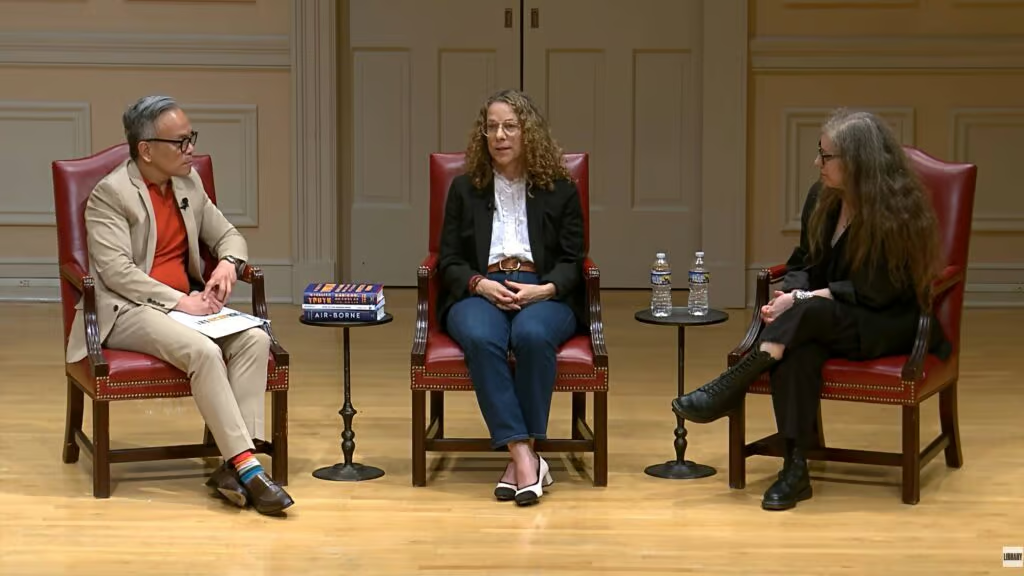
Keynotes at universities, conferences, and organizations worldwide, on topics from brainwashing to ethical decision-making in the digital age.

Media
Featured on The Michael Shermer Show, The Joe Rogan Experience, Armchair Expert with Dax Shepard, and more!
Featured Media & Interviews
Alongside my writing and speaking, I’ve shared my work on leading podcasts and platforms, reaching audiences around the world. Here are a few of my favorite recent appearances.

The Danny Jones Show
Harvard’s #1 Mind Control Expert fears MK-Ultra is STILL active, influencing courts & digital spaces

The Michael Shermer Show
Brainwashing is more common than we think, affecting anyone through various control techniques.
IndoctriNation
Rachel talks with historian Rebecca Lemov about brainwashing, identity, and reclaiming self-concept.
Invite Me to Your Stage or Team
Whether it’s a keynote, workshop, or consultation, I can help your group see the hidden forces shaping decisions — and how to respond with clarity. Ready to get started? Let’s start the conversation.